
The Jewish holidays are funny. Some of them, like Rosh Hashanah and Yom Kippur, are super important, and have also become a kind of shorthand to describe Jews who only set foot in synagogue on those days (“High Holiday Jews”). Others aren’t particularly significant, but became prominent as a result of their proximity to bigger Christian holidays (hi, Hanukkah!). Others like Passover are deeply important, and are observed entirely in the home, which is likely why in 2013 a whopping 70% of Jews reported attending a Passover seder.
And then there’s Tu B’Shvat, which starts tonight—and which sort of slips through the cracks of the Jewish calendar. Known as the New Year of the Trees, this agrarian holiday can feel far removed from our modern lives. But according to Rachel Rosenbluth, the artist-rabbi-scribe known online as Bluth, Tu B’Shvat is full of ritual relevance for our lives today.
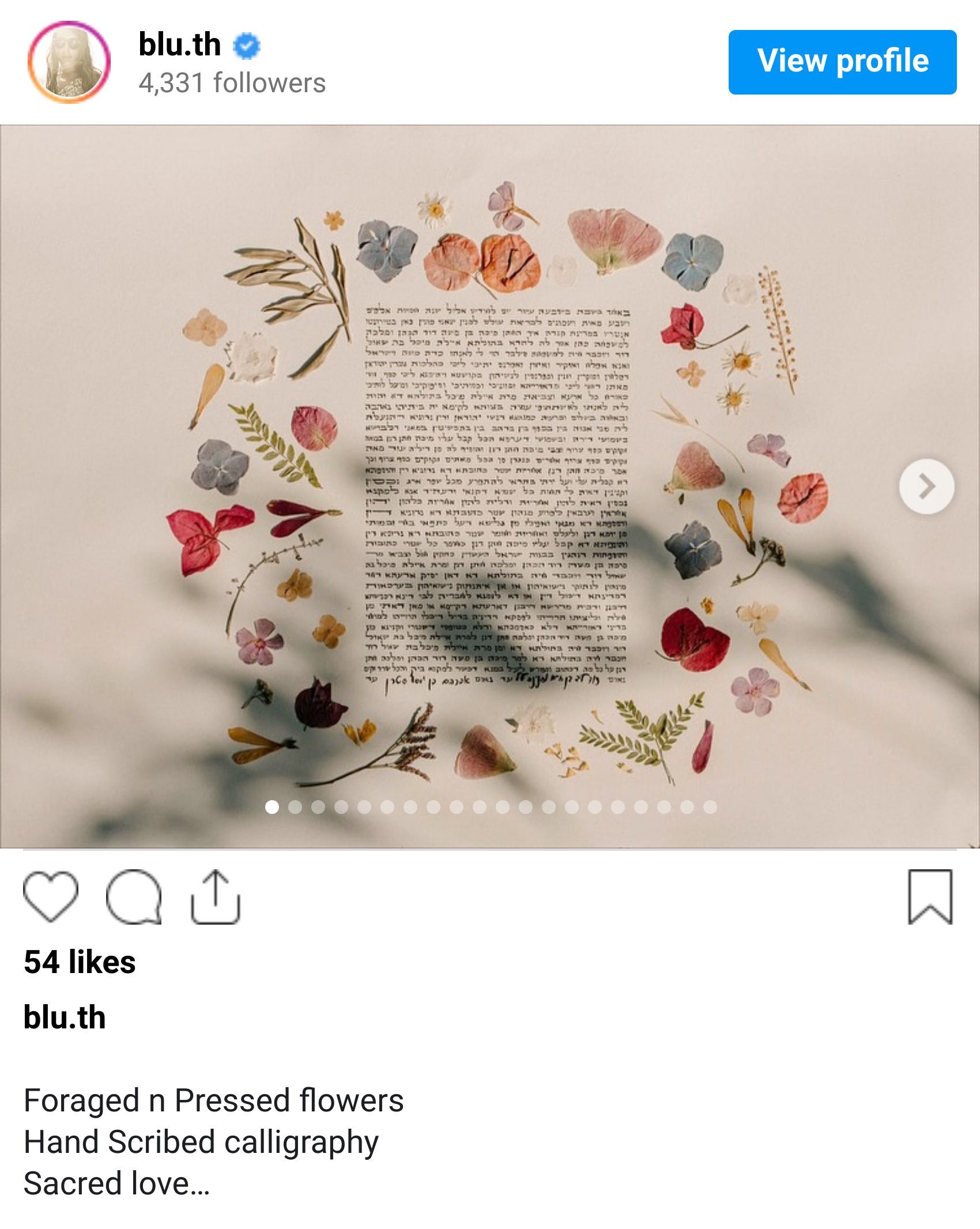
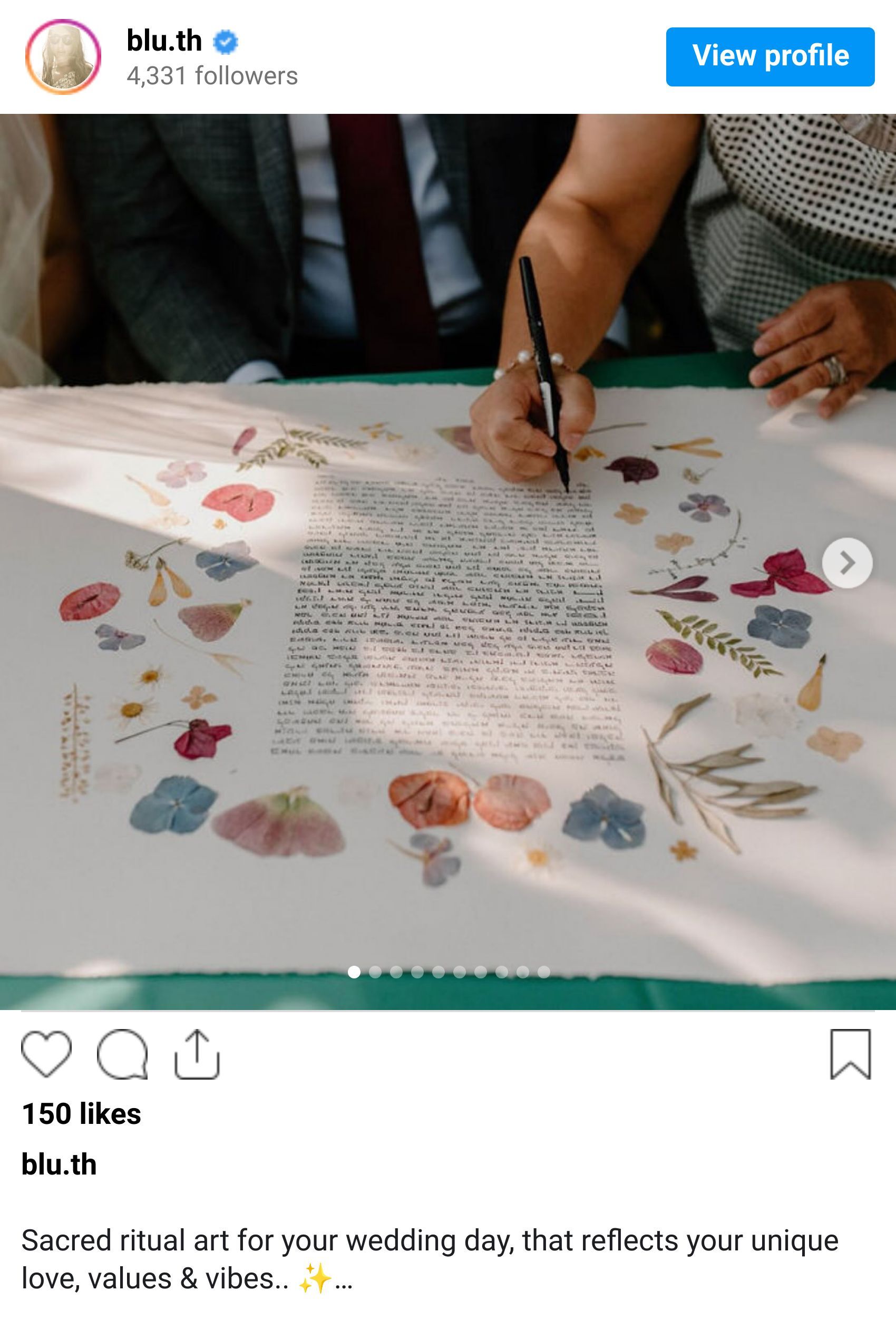
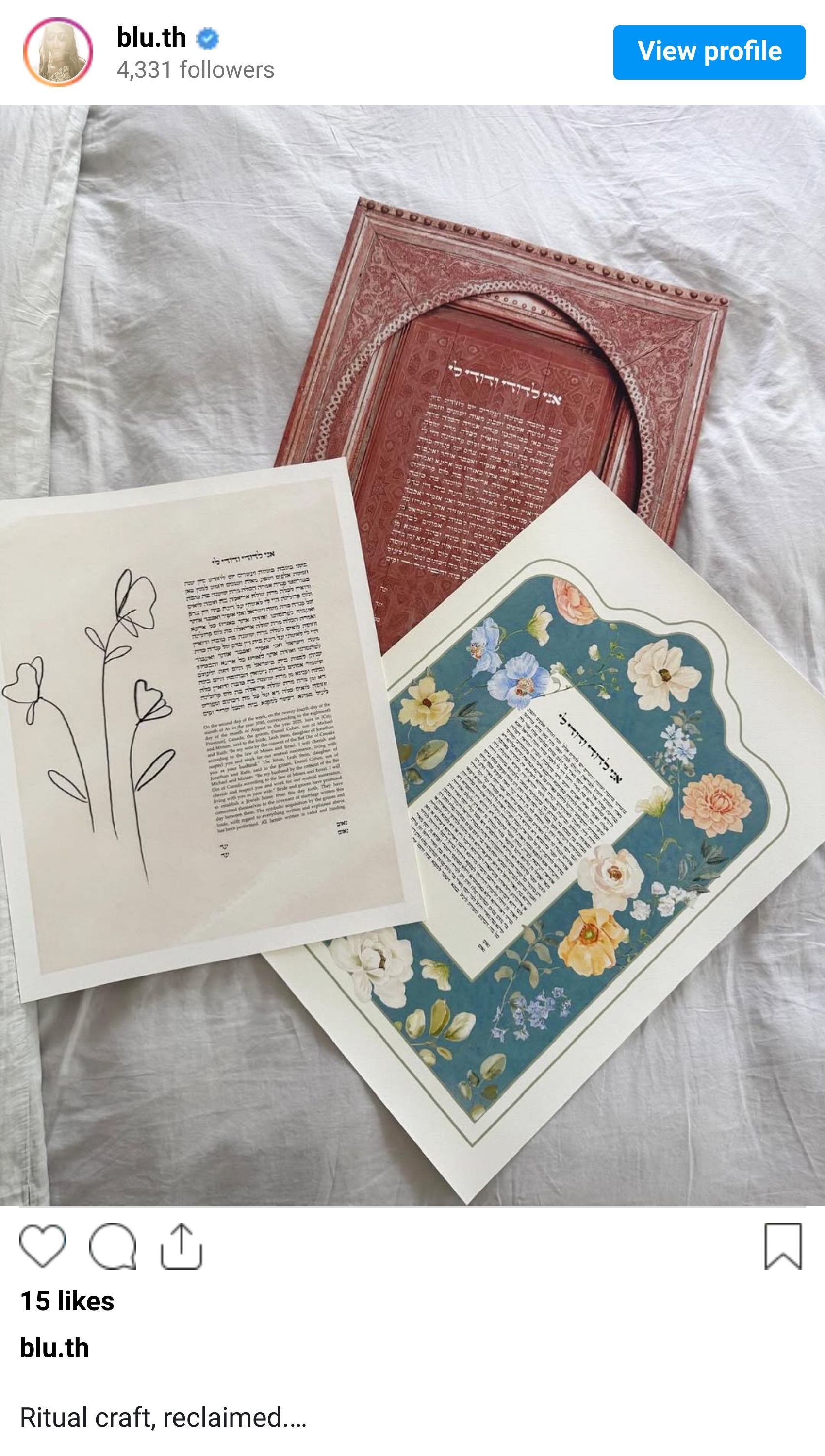
Bluth makes some of the most stunning ketubahs out there, drawing on nature for inspiration for her illustrated Jewish marriage contracts. Her signature offering is her pressed flower ketubah, which features hand-picked seasonal flowers arranged around Hebrew text that she scribes by hand. They are living works of art, showcasing Bluth’s deep ritual knowledge and artistic talent.
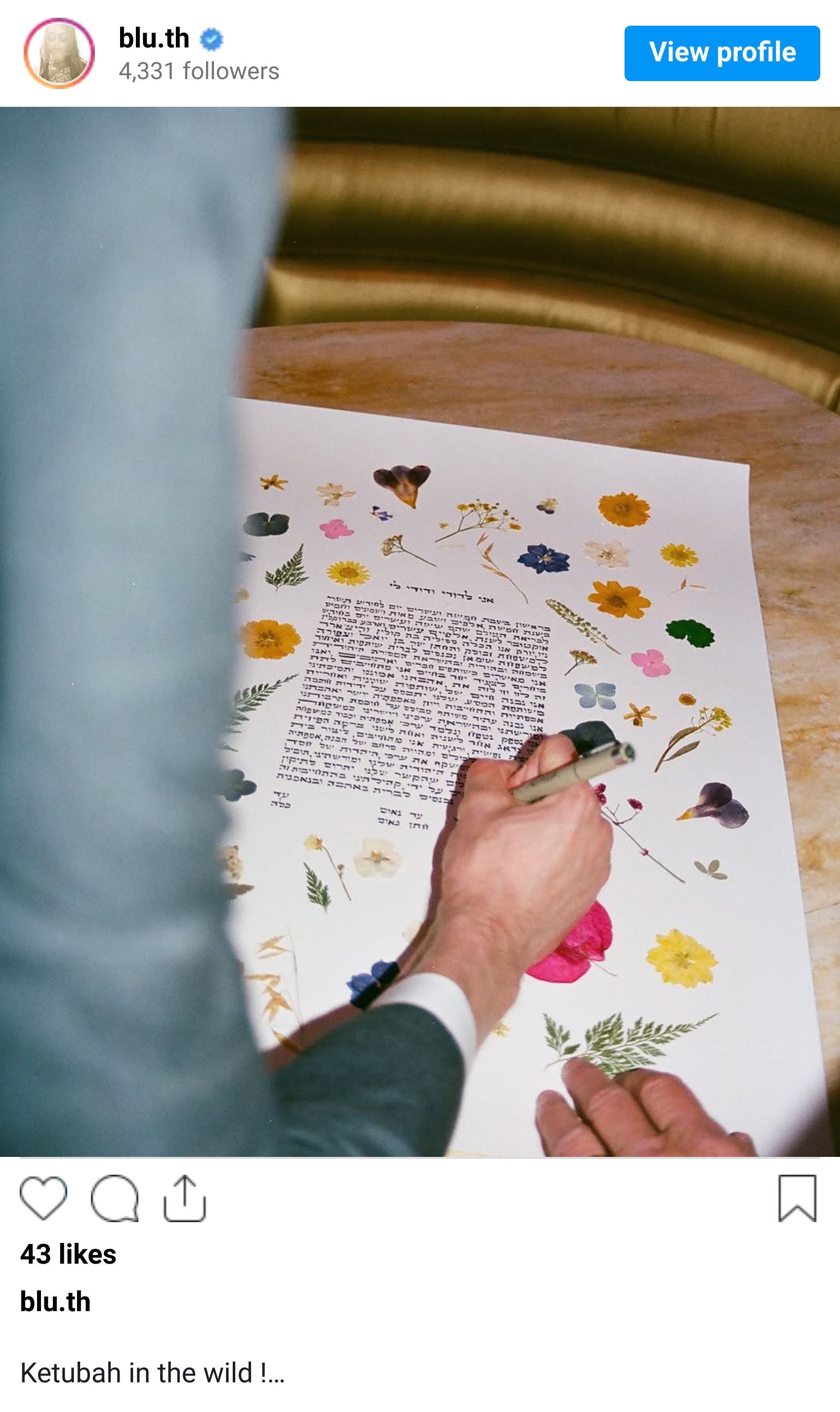
I met Bluth for lunch a few months ago at 12 Chairs Cafe, the Israeli restaurant in Soho, while she was in town from Toronto. She’s incredibly smart and soulful, a kind of Jewish polymath whose rabbinic and artistic journey stretches from Jerusalem to India and beyond. (We also talked a lot about our kids.) Bluth understands that people want Jewish ritual now more than ever, and that they also value aesthetics as part of it. In her work, the two coalesce seamlessly. She also sends her Jewish wedding guide to everyone who orders a ketubah.
Bluth launched a Substack this week called Ritual is Remedy, and shared a Tu B’Shvat guide. She called the holiday “quietly magical,” and wrote that it offers “a collective moment of reverence for the natural world and an opportunity to renew our relationship with the land, with food, and with the wisdom of Jewish tradition.”
I reached out to Bluth to talk about her work, those amazing pressed flower ketubahs, and why we should be paying more attention to Tu B’Shvat. Here’s our conversation:
Bluth! Tu B'shvat feels like the perfect time for us to chat, since so much of your work draws on the beauty of nature and its connections to Judaism. You also just launched a Substack, Ritual Is Remedy, with a special downloadable Tu B'Shvat guide. Before we get to the holiday, I'd love for you to tell us what you mean when you say ritual is remedy.
Life throws a lot at us—periods of deep instability or grief, moments of tremendous joy and celebration, times that demand profound care and effort, and all the ordinary moments in between. When I say Ritual is Remedy, I mean that ritual functions as a balm: a support system that helps anchor us and guide us through whatever season of life we’re in. It’s not a “should,” but a tool—a kind of spiritual technology we can return to for grounding, meaning, and support.
I call this functional ritual: ritual that meets us where we are and helps us navigate real life. It resources us, centers us, and helps refill our tank so we can show up more grounded, nourished, and able to give—to our lives, our communities, and the world around us.
Ritual is Remedy means that ritual is a balm and a wellspring. It offers both grounding and inspiration—to orient us when life feels unstable, and to elevate us when life is expansive and joyful. It’s an ancient, beautiful technology that has the power to support our thriving today.
My ethos of ritual is that it isn’t performative, rigid, or dogmatic. It’s rooted, responsive, and alive. The root of the word Halachah—Jewish law—is lalechet, meaning “to go” or “to walk.” I’m designing our rituals—the same ones that have carried our communities for centuries across various places and times—in ways that frame Jewish practice as dynamic: always moving, always walking with us. Ritual that actually makes sense in our lives. Ritual that is rooted in tradition but framed in a way that meets our values, identities, and circumstances.
And of course, with attunement to beauty and the design of the experience. The point is to open, not to close. To be embodied, soulful, practical, inspiring.
For a lot of us (myself included!) Tu B'Shvat can seem, well, not so relevant to our modern urban lives. Tell us why we should be paying more attention to this holiday, and what it can teach us that's ever more important today.
We are often referred to as the People of the Book, but I like to say that we are a People of the Garden. Our story begins in the Garden of Eden—and so much of our tradition takes place on land, in the wilderness, yearning to return to the idyllic garden. Many of our traditional and legal works are agricultural laws. We are a resilient people that has adapted over time and has created and influenced culture and philosophy and wisdom. And in that process of exile and oppression, or resilience and rebuilding—many of us have become disconnected from the land, from the earth as our home. The rabbinic tradition invited us into an intellectual experience—“Ta Shma,” come and listen, come and read and study and learn in the yeshivas. But the mystics, the kabbalists, were onto something deeper. “Ta Chazai” they said—come and see, come and experience. For the mystics the profound spiritual wisdom happened in caves or along streams, under trees and out in the fields. Nature.
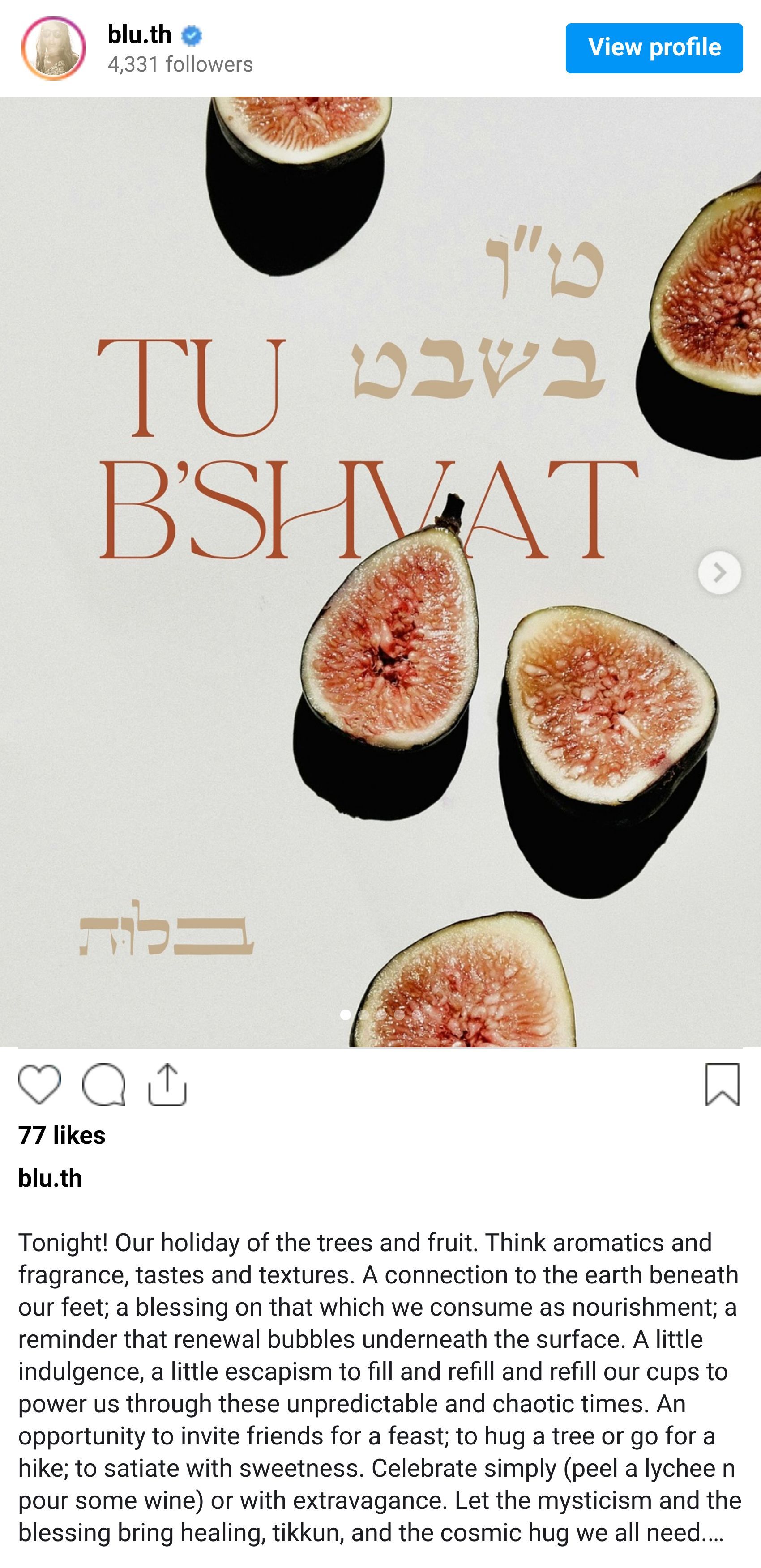
I’d say that Tu B’shvat is a sweet and gentle reminder to reconnect with the earth beneath our feet, with the trees in the fields or yards, with the fruits and nuts and foods that nourish us. In a way, it’s the most accessible holiday. It’s saying no matter where you live, this holiday isn’t about shul or history or narrative as much as it is about gathering around a table, eating yummy sensuous fruits, sipping on some wine and getting a little more connected, a little more rooted, a little more expanded. It’s about satiation and blessing the nourishment we have. It’s about watering the plant beside your bed. Leaving work early and getting some time on a hike to let your mind settle. In a world that’s chronically online, it’s an invitation back to earth, to our bodies, to a big deep breath outside. It’s a holiday with a lot of creative space for you to fill it however you’d like. Do you want to host friends and make a fruity feast? Do you want to take a hike or go to botanical gardens? Do you want to go deep with mysticism and blessing? Do you want to plant some trees? It’s one of the few holidays without strict prescriptive rules, so it makes it the most inviting and accessible!
You're a rabbi, and a scribe, and an artist. You're also one of the most soulful people I've ever met. Were you always drawn to spiritual practices? Or was it when you realized the connection between art and ritual that those connections deepened?
I studied in a yeshiva in Jerusalem in a basement with neon lights and no windows. It was a profound experience into text and tradition—an Orthodox yeshiva, the first of its kind to ordain women. I like to laugh and say they let me into the boys club. But then I realized maybe the boys club wasn’t that great. I mean, it was great, but it wasn’t whole. After smicha (ordination) I travelled to India and spent time in an ashram—replaced the study hall with an open air yoga space with birds and sunlight dripping in, and there I was invited to bring my practice into my body. That was a moment that strengthened my belief that art, beauty, embodiment and the experience of ritual, or the design of ritual, is tantamount to it being accessible and impactful.
Yehuda Abarbanel said “Beauty is that which moves the soul to love.” And Judaism is full of beauty, and I want to uplift that beauty. As a calligrapher of ketubahs, there’s the mysticism behind the stroke of the letters, the wisdom in their form and beauty. How letters make words which transform reality. As a ritualist, the way we set the tablescape for Tu B’shvat—the beauty is that which brings us in. The aesthetics of the experience is what moves it from intellectual or awkward to inviting and elevating.
Your pressed flower ketubahs are unbelievably beautiful. How did you start making ketubahs, and what's your process for creating these?
It started as a love of doodling and became a fascination with the mysticism behind Hebrew lettering. I studied sofrut, the traditional craft of Hebrew ritual calligraphy, the styles of sta”m (Torahs, mezuzahs, and tefillin) and began scribing ketubahs. I use ink with quill on klaf (animal hide). Materials of the earth, old crafts reimagined in new ways—minimalist designs, maximal ornate heritage styles, and of course my signature pressed flowers. What’s so beautiful about inscribing with a quill and ink on klaf is that the ink dries almost floating on top of the parchment, rather than being absorbed in as it would with paper. So it catches the light very beautifully.
The idea to bring pressed flowers actually came to me in a dream. I used to press the flowers I would pick in my Set of Shas, my massive set of Gemara books! I’ve gotten more sophisticated since then, but it’s a very crafty process. I scribe all sorts of texts from traditional to alternative for all types of love, to meet couples with all of their identities, values and vibes. It’s sacred art for sacred love.
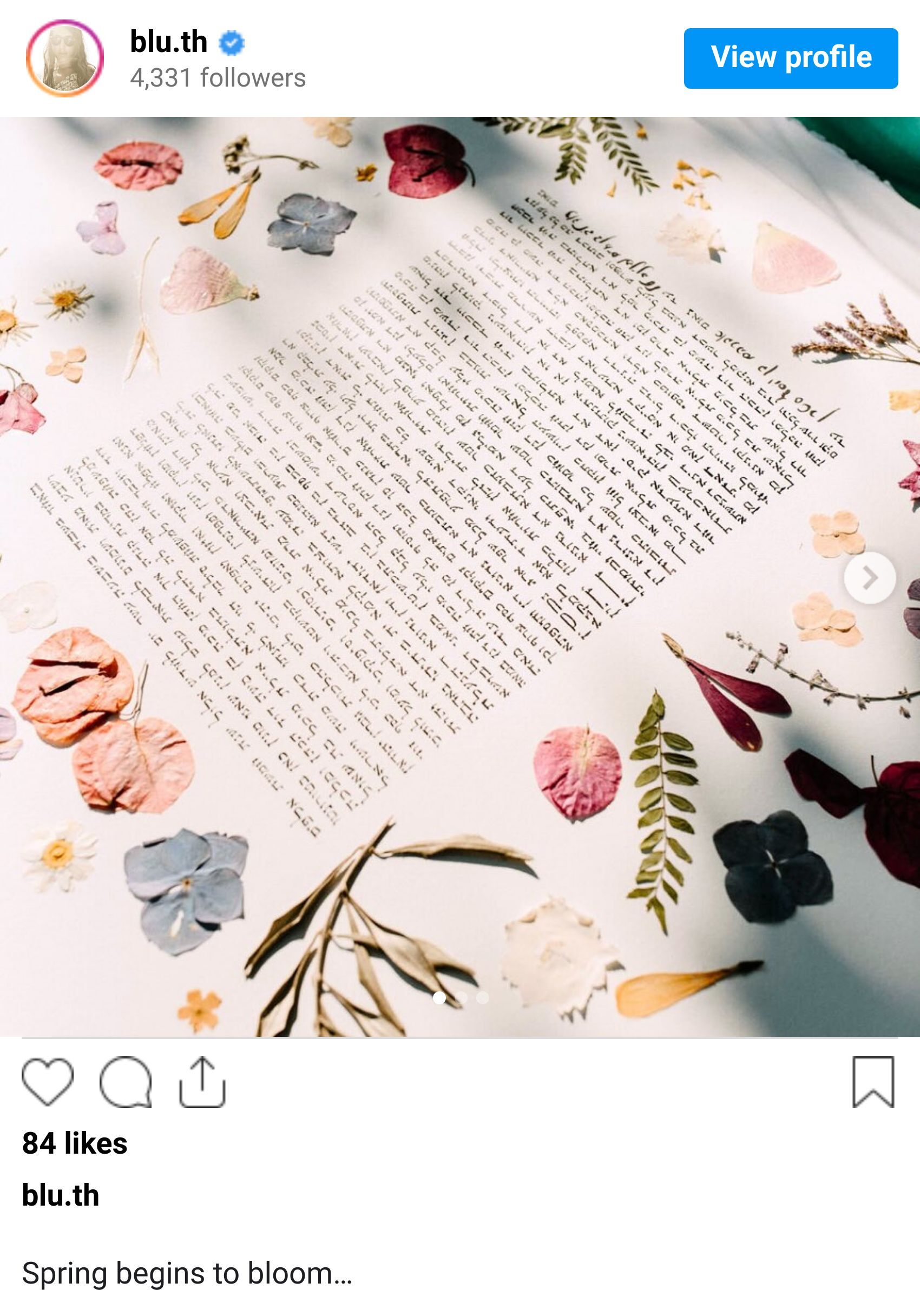
What does it feel like to have your work be part of a couple's most important moment, and then live as part of the home they create together?
There are a few things that last after the wedding itself. Obviously the love and the marriage should last a lifetime, and other than that it’s pretty much the ketubah! I love the idea of it being a statement piece in a couple’s home to remind them constantly of their commitments to care for each other, bring them back to the sweet memories of their wedding and early love, especially as they go through the seasons of life together. It almost feels as though it’s a document that blesses their love and also blesses their homes.
Do you have a dream ritual object you'd like to make? Or some Jewish ritual you'd love to put your own spin on?
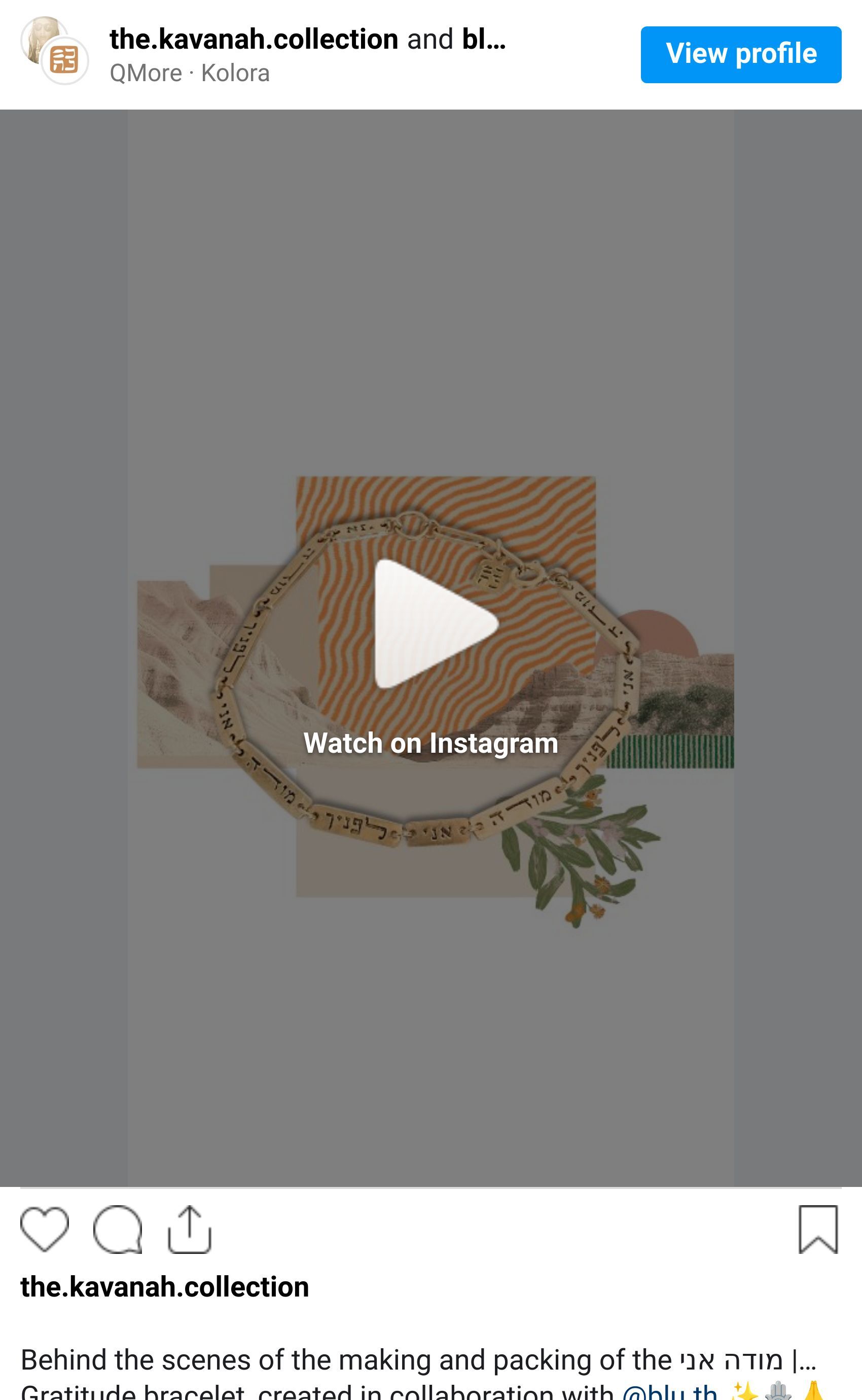
Something that I’ve been dreaming about for a while is actually coming true right now. I’m collaborating with two jewelers to make scribed jewelry! One collaboration is with the Kavanah Collection, and we have made a line of scribed wearable prayers. They are bracelets that carry an intention—scribed with words of gratitude, miracles, or for fertility. The other collab is with a Yemenite jeweler, Raz Akta, and we are making traditional amulets: beautiful, silver-encased necklaces with a little rolled scribed klaf inside. Amulets for protection or abundance.
I think I want to learn how to sculpt! To sculpt massive sculptures out of stone. It looks so laborious and slow in the best way possible, kind of the opposite of the pace of life these days.
Thanks to Bluth for sharing her wisdom and her art. You can download her Tu B’Shvat guide here.
Stay GOLDA,
Stephanie